Christine Daae
Christine Daae, the young Swedish soprano at the Paris Opera House, is the emotional and dramatic center of Gaston Leroux's The Phantom of the Opera. A seemingly ordinary singer who suddenly reveals a superhuman voice, she becomes the object of a deadly rivalry between the aristocratic Vicomte Raoul de Chagny and the disfigured musical genius Erik, the Opera Ghost. Her journey from a timid, father-fixated girl to a woman who must choose between love and terror drives the novel's central tragedy, and her ultimate act of compassion reshapes the fate of every major character.
Identity and Background
Christine Daae was born to a peasant fiddler in a small market-town near Upsala, Sweden. Her father, a great musician who taught her the musical alphabet before she could read, was renowned throughout Scandinavia for his playing. After her mother died when Christine was entering her sixth year, the father sold his patch of ground and wandered from fair to fair, strumming Scandinavian melodies while his daughter listened in ecstasy or sang to his playing. At Ljimby Fair, Professor Valerius heard them and took them to Gothenburg, maintaining that the father was the first violinist in the world and that the daughter had the making of a great artist. When the Valeriuses settled in France, they took Daae and Christine with them, and "Mamma" Valerius treated Christine as her daughter.
In Paris, Daae pined with homesickness and lived in a dream kept up by his violin, often locking himself in his bedroom with his daughter, fiddling and singing very softly. Each summer the family went to Perros-Guirec in Brittany, where the sea matched the color of his own country. There, at the "pardons" and village festivals, Daae played his saddest tunes on the beach, and Christine sang like an angel. It was at Perros that Christine first met Raoul de Chagny, a little boy who ran into the sea to rescue her scarf; they played together almost every day, and Daae gave the young viscount violin lessons. The children delighted in old Breton legends and in Daddy Daae's tales, especially the story of Little Lotte, who heard the Angel of Music when she went to sleep. Daae told Christine that every great artist receives a visit from the Angel at least once in his life, and he promised her, "When I am in Heaven, I will send him to you!"
After Professor Valerius died, his widow remained in France with Daae and Christine. Christine made wonderful progress and was prophesied to be the greatest singer in the world, but when her father died, she seemed to lose her voice, her soul, and her genius. She entered the Conservatoire, where she did not distinguish herself, attending classes without enthusiasm and taking a prize only to please old Mamma Valerius.
The Angel of Music and the Voice
Three months before the gala performance, Christine began hearing a voice in her dressing-room at the Opera—a voice so beautiful it seemed angelic. She believed it was the Angel of Music her father had promised to send her, especially when the voice confirmed this and asked to give her lessons every day. The voice, which she later learned was Erik's, taught her with a music that came from behind the wall, and in a few weeks she hardly knew herself when she sang. Her progress was kept secret between the voice, Mamma Valerius, and herself, and she lived in an ecstatic dream, waiting for the voice's command to astonish Paris.
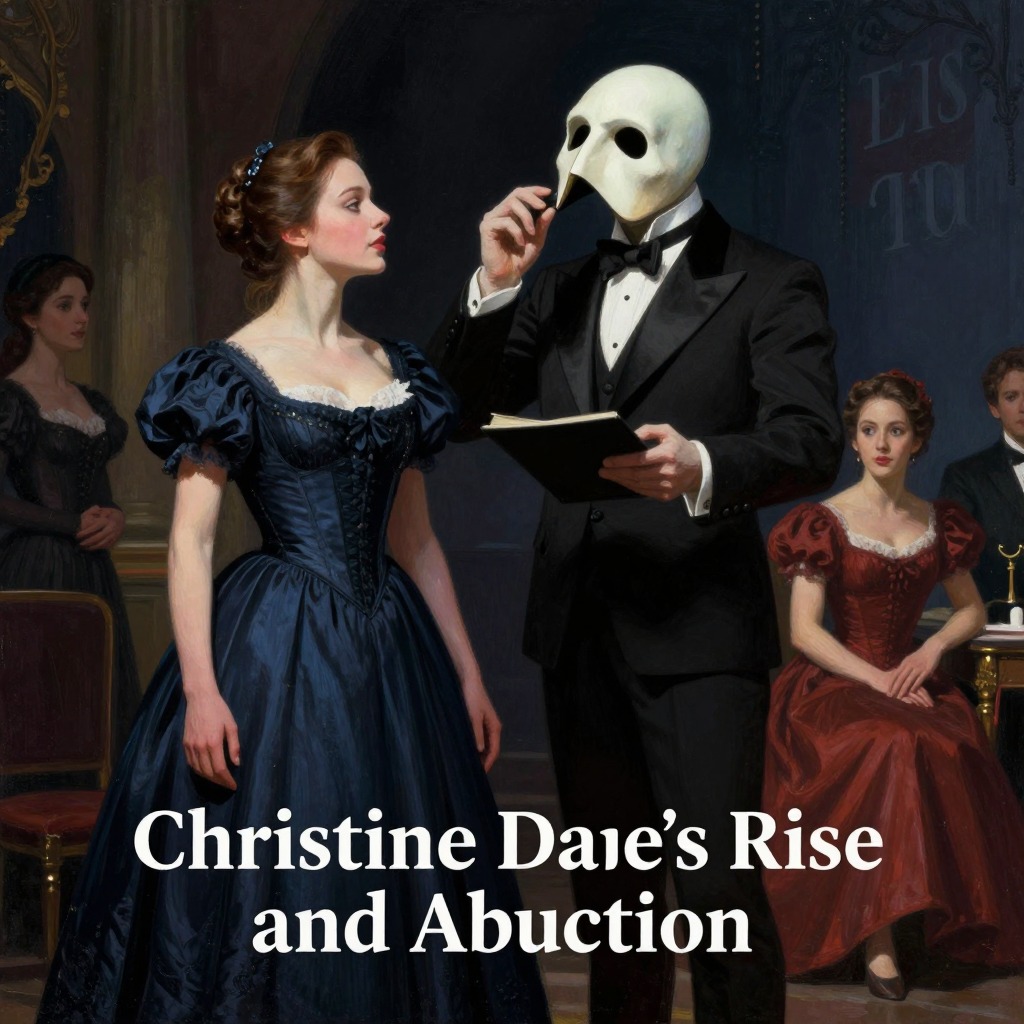
At the retirement gala for MM. Debienne and Poligny, Christine was called upon to sing in place of the ill Carlotta. She revealed a new Margarita, a Margarita of splendor and radiance, and the whole house went mad, rising to its feet, shouting, cheering, clapping, while Christine sobbed and fainted in the arms of her fellow-singers. The subscribers were astonished, for she had never shown such genius before, and they wondered why she had hidden it. Christine herself was frightened by what had happened; she wrote, "I don't know myself when I sing," and she refused to appear at a charity concert, acting as though she were no longer mistress of her own destiny.
The Love Triangle with Raoul and Erik
Christine's relationship with Raoul de Chagny was rooted in childhood memory. When Raoul reminded her in her dressing-room that he was "the little boy who went into the sea to rescue your scarf," she laughed and pretended not to recognize him, because the voice—Erik—was jealous and had forbidden her to acknowledge any earthly love. She wrote to Raoul, asking him to meet her at Perros on the anniversary of her father's death, and there she told him that she had been visited by the Angel of Music. Raoul, who had heard the voice behind the door, was skeptical, but Christine insisted that the voice was real and that it came to her in her dressing-room daily.
Christine's feelings were torn between her love for Raoul and her terror of Erik. She confessed to Raoul that Erik had carried her off to his house on the lake, where she discovered he was not an angel but a man—a man with a death's head for a face. She described how she had torn off his mask and seen his horrible ugliness, and how he had wept and begged for her love. She felt horror and pity for him, and she admitted, "He fills me with horror and I do not hate him." When Raoul asked if she loved Erik, she replied, "No," but she could not deny the hold he had over her.
The Abduction and the Choice
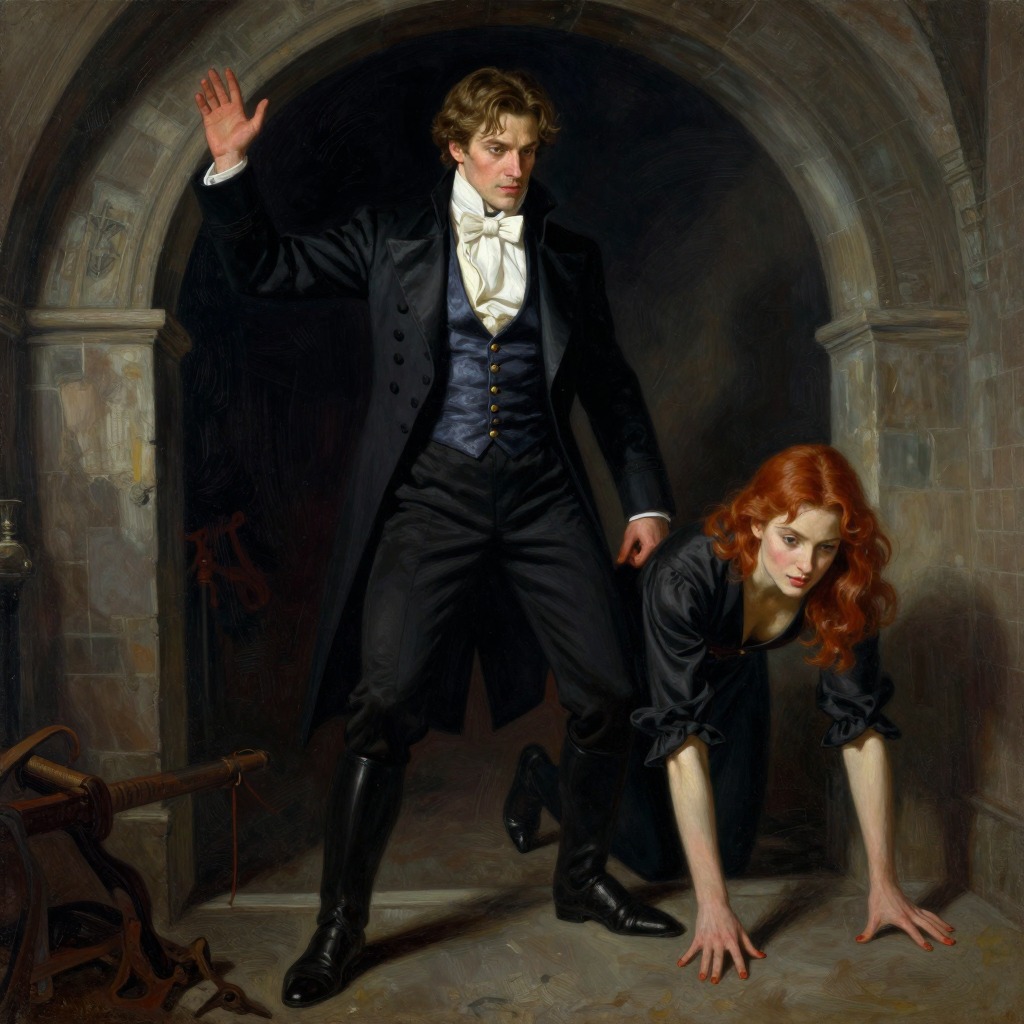
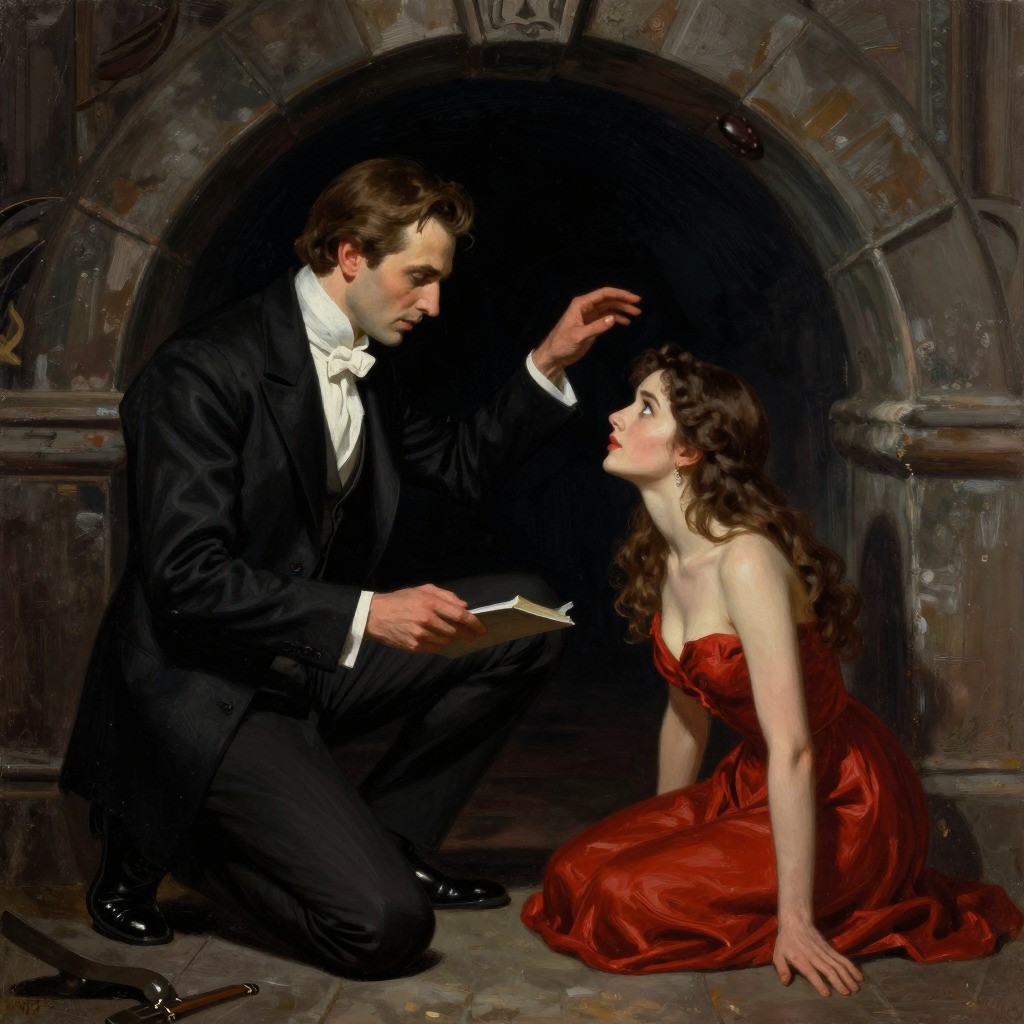
On the night of the performance of Faust, Christine was abducted from the stage in the Prison Act, at the moment when she was invoking the angels. She vanished before the eyes of thousands, and Raoul, convinced that Erik had taken her, rushed to the cellars with the Persian to rescue her. They found themselves in the torture-chamber, where they overheard Erik giving Christine an ultimatum: she must choose between the wedding mass and the requiem mass, between marrying him or seeing everyone die. Erik had filled the cellars with gunpowder and threatened to blow up the Opera if she refused. Christine, desperate to save Raoul and the Persian, turned the scorpion, which flooded the powder-magazine and saved them all.
After the ordeal, Erik, moved by Christine's tears and her act of compassion, released Raoul and allowed the lovers to go. He gave Christine a gold ring as a wedding-present and made her promise to return and bury him when he died. Christine kissed him on the forehead, the first time she had ever kissed him, and she and Raoul left together, disappearing from the world to seek a priest in some lonely spot where they could hide their happiness.
Change and Ending
Christine Daae's story ends with her disappearance from the Opera and from public life. She and Raoul withdrew far from the world, and the narrator suggests that they may still be found in Norway, where the lonely echoes of the North might repeat the singing of her who knew the Angel of Music. Christine's final act was one of mercy: she kept her promise to Erik, returning to bury him with the gold ring on his finger. The narrator, who discovered Erik's skeleton, recognized it by the plain gold ring, which Christine had certainly slipped on his finger when she came to bury him. Christine's compassion, her ability to see the suffering beneath the monster's ugliness, ultimately redeemed Erik and allowed her to escape with the man she loved.
Narrative Role and Significance
Christine Daae is the catalyst for the novel's central conflict and the embodiment of its themes of love, beauty, and the monstrous. Her voice, which is both a divine gift and a curse, draws together the aristocratic Raoul and the outcast Erik, forcing a confrontation between the world of normalcy and the world of the underground. Christine's journey from innocence to experience, from fear to compassion, mirrors the novel's exploration of the nature of love and the possibility of redemption. Her final choice—to save Raoul and the Persian by turning the scorpion, and to show Erik mercy—demonstrates that true love is not merely romantic but also self-sacrificing and forgiving. Christine Daae remains one of literature's most memorable heroines, a woman whose voice could move the world but whose heart was torn between two very different kinds of love.